Patrick H. Winston · MIT · 63 minutes
How
Ideas
Survive
He opened the same way every year. Your success in life will be determined largely by your ability to speak, your ability to write, and the quality of your ideas — in that order.
Knowledge, practice, talent. He wrote the t small, and meant it: what really matters is what you know.

It's a matter of how much knowledge you have, how much you practice with that knowledge, and your inherent talent. And notice that the T is very small. What really matters is what you know.
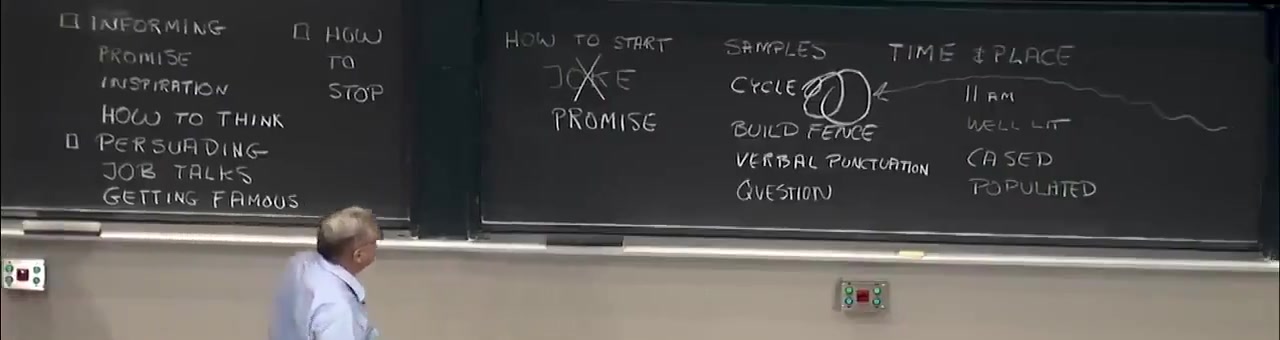
How to start
Under this heading he wrote two words. Then he drew a line through the first one.

Some people think the right thing to do is to start a talk with a joke. I don't recommend it.
The reason is timing, not taste. In the first minute the room is still putting laptops away and adjusting to the sound of a new voice. Nobody has calibrated yet, so the joke lands into a room that is not listening — and a joke that falls flat at the start costs more than the joke was worth.
What goes there instead is a promise: a specific statement of what the listener will be able to do at the end of the hour that they cannot do now. It is not a topic. A topic asks the audience to spend attention on faith. A promise tells them what they are buying.

You want to tell people what they're going to know at the end of the hour that they didn't know at the beginning of the hour. It's an empowerment promise. It's the reason for being here.
He then makes the promise he has just described, about the hour you are in. The lecture demonstrates its own first rule inside ninety seconds of stating it.
4 samples
Four habits he says are always on his mind while he is talking. They are not style. Each one is a repair for a specific way an audience loses the thread.

It's a good idea to cycle on the subject. Go around it, go around it again, go around it again.
The justification is not that the audience is slow. It is that at any given moment about twenty per cent of the room is fogged out, and which twenty per cent keeps changing. Saying a thing once reaches four listeners in five. Saying it three times, spaced, reaches almost everyone at least once.

In explaining my idea, I want to build a fence around it so that it's not confused with somebody else's idea.
The fence is made of negatives. This is an arch. This is not an arch. That is not an arch either. In technical work the same move is one sentence long: my algorithm may look like Jones's, except his is exponential and mine is linear. Without the fence, a listener files your idea under the nearest thing they already know, and it stops being yours.

Because people will occasionally fog out and need to get back on the bus, you need to provide some landmark places where you're announcing that it's a good time to get back on.
Numbering, enumerating, restating the outline — these are seams. They exist for the listener who drifted and is now trying to work out where everyone else is. Without seams, a moment's inattention is unrecoverable and that listener is gone for the rest of the hour.

How much dead air can there be? How long can I pause? I count to seven seconds. It seems like an eternity to me.
Sit through it
He says seven seconds feels like an eternity. The only way to find out is to wait.
Seven seconds is the standard wait, and the question has to be chosen with care: too obvious and nobody will answer for fear of looking simple; too hard and nobody has anything to say.
The tools
Three sub-headings sat under this box: time and place, boards and props, projections. They are ordered by how much of the outcome they decide before you have said a word.
Time & place
Four conditions, each with a reason. Tap one.

People will see the slides better if we turn the lights off — and then I reply, it's extremely hard to see slides through closed eyelids.

I imagined that all the seats were filled with disinterested farm animals. That way I knew that no matter how bad it was, it wouldn't be as bad as that.
Boards & props
He separates the two jobs sharply. A board is for informing. Slides are for exposing. Teaching is the first job; a conference talk is the second; and the tool that suits one is wrong for the other.
A board has three properties he names. It is graphic — you can draw, not just list. It has the right speed, because the rate at which a hand writes is close to the rate at which a room absorbs. And it is a target: it gives your hands somewhere to be.

The speed with which you write on the blackboard is approximately the speed at which people can absorb ideas. If you go flipping through a bunch of slides, nobody can go that fast.
The hands problem is worth its own note. Speakers who become aware of their hands put them in their pockets or behind their back, both of which read badly — and in some places very badly. He was once in a convent in Serbia where a nun pulled his hands out from behind his back, because concealing them suggests you are concealing a weapon.
Props do something a slide cannot. He builds the case from Ibsen's Hedda Gabler, where a potbelly stove sits on stage from the first scene, its fire growing as the tension does, until you know with certainty that the manuscript is going into it. Then a spinning bicycle wheel with duct tape on the rim, which turns a right-hand-rule problem that mechanical engineers get right half the time into something you simply see. Then a pendulum released from against the wall, which swings out and returns to stop at the lecturer's nose.

When you're sitting up there watching me write on the board, all those little mirror neurons in your head, I believe, become actuated, and you can feel yourself writing on the blackboard.
He offers this as his own speculation rather than as settled science, and labels it that way — his lunatic fringe view. It is the one explanatory claim in the hour that carries a hedge, and he puts the hedge on it himself.
Projections
A stranger recognised him in an airport terminal and asked him to critique a job-talk deck he had not seen.

You have too many, and they have too many words. How did you know? … Because it's always true. There are always too many slides, always too many words.
He then commits the offences deliberately, from the wrong side of the room, and strips them off one at a time. Tap a charge to see what he does about it.
- The audience reads faster than you speak, so the slide wins and you become the distraction. Cut until what is left is a handful of words you can say aloud without reading them.Condiment, not main course
- People in the audience know how to read, and reading to them annoys them. Once the words are gone you are no longer licensed to say them, which is the point.Remove the text, keep the sentence
- A speaker on one side and a slide on the other turns the room into a tennis match, and the audience spends the hour looking back and forth instead of at either.Stand with your material
- Decorative template furniture is always a distraction and never carries information. It is the first thing to delete.Delete it
- Nobody needs telling forty times whose deck they are watching. Logos are the second thing to delete.Delete it
- The title is spoken. Leaving it off the slide buys attention back for the speaker, which is where the argument actually is.Say it instead
- Once the words are down to a handful, the bullets in front of them are doing nothing at all.Eliminate clutter
- Minimum 40 to 50 point. Thirty-five is already too small — not because it cannot be read, but because a small size is what lets you fit too many words on in the first place.40–50 pt minimum
- You cannot use one without turning your head away, and the moment you do, eye contact and engagement are gone. Put a numbered arrow on the image and refer to it by number.Arrow number one
- Print the deck and lay it out on a table. Seen all at once it is obvious whether there is any air in it, and there usually is not.Print it, lay it out

What do you see? You see the back of my head. I have no eye contact, no engagement, nothing. … A student said: you know what, we could all leave and he wouldn't know.
He allows exactly one exception to all of it. A slide so overwhelming that not understanding it is the point — he calls it a hapax legomenon — is permitted once per talk, once per paper, once per book. Twice and it is no longer a device, just clutter.
Informing
Three sub-headings: promise, inspiration, how to think. Asked by his department chair to explain what makes a lecturer inspiring, he found he had never thought about it, so he went and asked people.
Incoming first-years told him they had been inspired by a high-school teacher who told them they could do it. Senior faculty named someone who helped them see a problem a new way. Different answers, different decades — but one element was in every single account: the person was visibly exhibiting passion about what they were doing.
That is why he will stop a lecture on resource allocation to show a map-colouring program grinding away at a problem that would outlast the solar system, and then the same program finishing in seconds after one adjustment. The content is scheduling. The transmitted signal is look how good this is.
The third sub-heading is the one he treats as the real question. Faculty say their job is teaching people how to think, and then cannot say how. His answer is that we are storytelling animals: thinking is built out of stories, starting with fairy tales and running through law, medicine and engineering. So teaching someone to think means handing them the stories they need, the questions to ask of a story, ways of assembling stories, and ways of judging whether a story is reliable.
Persuading
Here the lecture quietly changes subject. Up to this point it has been about getting an idea into a mind. From here it is about getting an institution to act.
Job talks
He asked two colleagues on a Navy science board what they look for in a faculty candidate. The answers came back immediately and did not need discussion.

They have to show us they've got some kind of vision. … They have to show us that they've done something. … How long does a candidate have to establish these two things? … Five minutes.
Vision is a problem somebody cares about plus something new in your approach to it. Having done something is shown by enumerating the steps needed to get there — you do not have to have finished them all, but you have to be able to name them. The talk then closes by listing contributions, mirroring those steps. He calls the shape a sandwich.
Two practical notes attach to this. Do not rehearse in front of people who already know your work: they will hallucinate material into your talk that is not there, and that includes your supervisor. And the hostility of a question tends to fall with the age of the questioner, because the young ones are trying to show the old ones how clever they are.
Getting famous
He treats this as a legitimate professional concern rather than vanity, and argues for it from a dinner beside Julia Child.

Is it fun to be famous? … You get used to it. But you know what occurred to me: you never get used to being ignored. … Your ideas are like your children. You don't want them to go into the world in rags.
The mechanism he offers is a five-pointed figure he calls Winston's Star, reverse-engineered from his own doctoral work on arch learning, which became mildly famous without his understanding why until years later. Tap a point.
He is explicit that the star was not a plan. He noticed afterwards that the work which travelled had all five, and the work which did not, did not.
How to stop
Two separate decisions: what is on the screen while people are filing out, and what the last words out of your mouth are.
The final slide
It will be up for a long time — through the questions, while people gather their things. Tap each candidate for his verdict.

These are perfectly legitimate conclusions that nobody cares about. What they care about is what you have done — and that's why your final slide should have this label: Contributions.
The final words
A joke works here, where it failed at the opening, because by now the room has adjusted to your voice. A benediction works — he plays Chris Christie and Bill Clinton closing conventions, and points out Clinton pressing his lips together to stop himself saying the obvious thing, then saluting instead.

You will not go to hell if you conclude your talk by saying thank you, but it's a weak move. … It suggests that everybody has stayed that long out of politeness.
Once applause has started you can mouth a thank you and nothing is lost. It is only weak as the last thing you do, because it reframes an hour of attention as a favour the room did you.
What he recommends instead is to salute the audience — say something true about what it was worth to be in that room with those people. Then he does it, on himself, in the last thirty seconds of the hour.

It's been fascinating to see what you folks are doing here at MIT. I've been much stimulated and provoked by the kinds of questions you've been asking. … So that salutes the audience.
One pipeline
Read end to end, the hour is not a list of tips. Every rule in it defends one stage of the same path, and every rule is a response to a specific way that path leaks.
Idea
The thing you actually know, before anyone has to receive it.
Representation
Board, prop, slide, story. Chosen by whether you are informing or exposing.
Attention
A finite budget. Every logo, bullet and dimmed lamp spends some of it.
Mental model
Built by fences and near misses — what the idea is, and what it is not.
Encoding
Cycling, props, demonstrations. Exposure is not the same as storage.
Retrieval
Symbol, slogan, surprise, salience, story. Handles for later.
Transmission
The idea moves again without you in the room. That is survival.
The same logic governs the parts that look like etiquette. If everything on a slide is emphasised, nothing is. If your hands move constantly, movement carries no information. A signal is only useful because it differs from what surrounds it — which is a statement about channels, not about manners.
Where it thins
The communication layer is modelled closely and tested against forty years of a room. The layer above it is largely taken as given. Once the subject becomes job talks and recognition, the outcome is also being decided by network position, prestige, gatekeeping and who is in the room — and the hour treats those as fixed conditions rather than as variables. Good work plus excellent transmission is necessary, and it is not sufficient.
Several of the rules are also heuristics wearing the clothes of universals. Eleven in the morning is advice for a residential campus. A chalkboard assumes a room with one. Dead air for seven seconds assumes an audience whose culture reads silence as invitation rather than as failure, and a speaker whose authority in the room makes waiting safe. Where the lecture says always, the honest reading is usually in this room, with this kind of audience, for this kind of talk.
What survives the objections is the architecture underneath them. Attention is finite, memory needs encoding rather than exposure, and an idea that cannot be retrieved later did not arrive. Change the room and the specific rules change with it; the four constraints do not.
Circulate
One card, one tap. Pick a card to post or save it.